The Interview: Art, Economics, and Global Perspectives
Speaker 1: Okay, can you give me an introduction of yourself?
Aafreen Diyanah: Hi, my name is Aafreen Diyanah. You can call me Aafreen. I'm currently a second-year Economics student at Kobe University.
Speaker 1: Nice! Can you tell me what things you are currently grateful for?
Aafreen Diyanah: Well, currently, I'm very grateful for the fact that I am at Kobe University itself. When I look back at how much I wanted to be here, I realize that the dream actually came true. So, to show gratefulness for that dream, I should also do well in my studies. Aside from that, I'm also grateful for my part-time job. That was one of my resolutions for this semester—to find a part-time job—and the fact that I managed to find one makes me really happy.
Speaker 1: I feel like small things in our lives really make us happy, right?
Aafreen Diyanah: Definitely. I think even now most of the things that bring me joy are the smaller things. Even nice weather, like right now this season when the sun is out, can bring a lot of joy.
Speaker 1: Really, I fully understand that. So, what is your current hobby?
Aafreen Diyanah: Well, recently I've been trying to lower my screen time, so I picked up a hobby that I never really outgrew. I still like it very much, I just hadn't made time for it. Then I realized I actually do have a lot of time, but I was spending it on my screens instead, which isn't really good. So, I picked back up on journaling, scrapbooking, and collecting stickers. Basically, art-related stuff. I really love art-related things.
Speaker 1: I feel like it's interesting how an Economics student has such a strong interest in art. Would you like to tell me more about that?
Aafreen Diyanah: Actually, sometimes I do think it's pretty ironic. I do wonder if I was supposed to be an art student instead! But here I am. Even though I'm taking Economics and have quite a fixation on art, I don't really think those two things must be separate. It's not like if you're a science or engineering student, your whole life must revolve only around that. I also don't like the stereotype that if you're an art student, then that's the only thing you're meant for.
I think it's nice to have a little balance between things. I love Economics as a subject. But I also think that having art as a hobby or a "side quest" in your life can bring a good balance. At least you have a way to enjoy a little bit of here and there, a little bit of this and that, and not just fixate on one thing for your whole life. That way, in the future, you'll have options.
Speaker 1: I fully understand. As a person who loves to do side quests as well, that kind of balance between Economics and arts is just perfect. I also heard about your recent trip to Paris, and I personally think it helps immerse yourself in art a little bit more, especially when looking at the Renaissance architecture and stuff. Would you like to tell us more about that?
Aafreen Diyanah: Sure! I went on a trip—it was more of a kenshu (study) trip, meaning fieldwork—to Paris and Belgium under Kobe University. At Kobe University, there's this program called GCP (Global Challenge Program). It basically offers overseas programs that send you to many places, like Canada or Australia, and most of these programs are based on various themes.
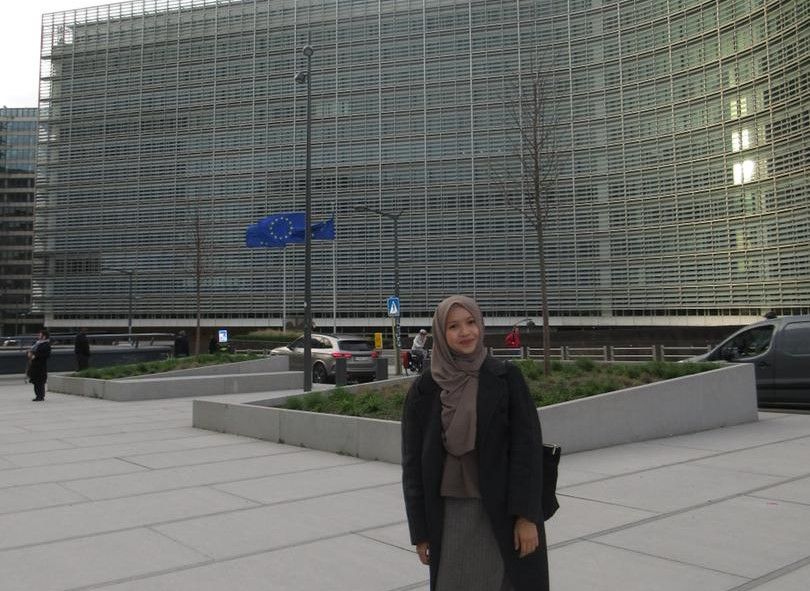
For my program, I went to the GCP program for SDGs fieldwork in Paris and Belgium. It was focused on international organizations and the SDGs. We had to do presentations on the SDGs at universities in Paris and Belgium, and we also got to visit international organizations like the OECD, the UNESCO headquarters, and an EU department in Brussels.
But back to the art aspect—we also were allowed to go on our own fieldwork around Paris and Brussels. We were able to explore on our own, so obviously, being there already, I took the chance to go to museums and check out what's gathered around Paris. One of the things that fully shocked me was how much their society itself appreciates art.
When I went to these museums, I noticed it wasn't just tourists; there were also Parisians themselves, especially the elderly. They would be walking around these museums with immersive headphones. Seeing the way that art is just a part of their life, the way they have art incorporated into their whole society and daily lives, is something they actually appreciate. It feels like a really nice environment to have, especially right now as we are entering the AI generation where everyone seems to start undermining the true value of art.
For your information, I'm on the side that is pretty much against AI-generated art. You know how people ask AI to make a Ghibli character, for example? I am pretty much against those trends because I think AI-generated art is pretty stiff and it's a dishonor to real art made by humans.
Speaker 1: Yeah, exactly. I also kind of feel like those AI-generated arts might be helpful for some types of references, but for our whole life, there's no kanjou (emotion) inside it. Do you think so?
Aafreen Diyanah: There's definitely no emotion in it. It definitely takes away the beauty of art made by humans. In a world where that's becoming more of a norm—especially when you see a lot of companies starting to use AI-designed art instead of hiring actual human graphic designers—going to Paris, a society that still very much co-ops real art and appreciates art made by humans, somehow gave me a sense of hope. It was like, "Oh, okay!" It also made me think back to how in Malaysia, we do not really appreciate art at all. Especially art-related degrees; they are not being appreciated at all. Thinking about how big of a gap this is made me realize how nice it would be if we could also do something to appreciate more of the artists in our own country.
Speaker 1: Exactly, because I feel like Malaysians have a lot of talented people, however, a lot of people often overlook them.
Aafreen Diyanah: Yes, and often, people with talent are told to just put that talent aside and do something that can actually bring you money. That's how the view is in Malaysia.
Speaker 1: Exactly. So, after your fieldwork trip to Paris and returning to Kobe University, what is the most heartfelt achievement that you felt throughout this year?
Aafreen Diyanah: Honestly, flying to Paris on my own from KL. Just an interesting fact: even though it was a university program, for some reason, the nature of the program depends on the sensei (professor) handling it. We were pretty much given a lot of freedom, so our sensei told us to buy our own flight tickets and accommodation. It honestly felt more like a personal trip on the side of university, rather than a rigid university trip. Because we were given a lot of freedom, I flew to Paris on my own from KL. This was pretty much the first time in my life going on an overseas trip, so it was my first major trip abroad. The moment I stepped into Paris, I was pretty touched because I was seeing people from all over the world. There were people with all different skin colors and religions. It felt deeply moving because I’ve always been someone who likes things on a global scale. I love being in international spaces, so being able to actually be there in real life and see people from all over the world made me feel like, "Oh, okay, the world is truly big."
Speaker 1: I feel like as a person who loves city-hopping myself, having the opportunity to see the world from another land is really a grateful and eye-opening experience. How do you feel about it?
Aafreen Diyanah: It was definitely very eye-opening for me. One thing I would really point out is how important it is to go out and see the world. In this case, I was actually pretty shocked to see how many hijabis there were in Paris!
I went there with this pretty ignorant thought because, obviously, we in Malaysia are constantly told about how rampant Islamophobia is in Paris and France itself. So, I was a bit worried about that part. But when I went there, I realized how much I just didn't know. To describe it: in Paris, you walk anywhere and you can see a hijabi, and they're not just tourists, they are actual Parisians! They are actual Parisian’s hijabi. To put it in perspective, I went to do my prayers in malls, and when I went to shops like H&M, Uniqlo, and Zara—the main three—I noticed there were a lot of hijabi staff working there.
What I wanted to point out is that it made me realize how I was worried about going to Paris because I was afraid of being a minority or facing Islamophobia, but when I went there and saw how normalized it is for hijabi staff to be there, it made me realize that while Islamophobia can still happen, they are still being allowed to work and be a part of society. They can work in mainstream public spaces.
When you compare it to us currently living in Japan, as a hijabi minority in Japan, it's very much common to face barriers because of our hijab. I feel like it would probably be very hard for us to work in a Uniqlo or something open to the Japanese public here. It was then that I realized the true minority is us here in Japan, not them in Paris!
So yeah, I felt like I was pretty ignorant before, but it was more because I just didn't know. We hear people in Malaysia say, "Oh, Paris is very Islamophobic, are you sure you want to go there?" But when you actually go there, you see that maybe it's not really like how everyone says. I think it's way better to actually go to that place, see the world, and make your own judgment based on what you see and experience, rather than just believing whatever you hear from the media.
Speaker 1: Exactly, I feel like the experiences we see with our own eyes will always beat the things we hear from others.
Aafreen Diyanah: Definitely.
Speaker 1: And I'm actually really grateful how your trip to Paris also opened your eyes to the differences between societies in Malaysia, Japan, and another part of the world, especially in Europe, which is a whole other region for us Asians.
Aafreen Diyanah: Yes.
Speaker 1: So, may I know what your future goals are that you would like to pursue? Maybe some hobbies you want to learn more about, or another part of the world you want to explore?
Aafreen Diyanah: Well, I've always been into language learning. Right now, I'm learning intermediate Russian. After coming back from Paris, I realized, "Oh, I think I want to learn French too!" Because I think it's also really important to point out that going to Paris, obviously they know English, but they don't really speak it because the main language itself is French. The workers and staff will naturally speak French to you first. So, it was my first time being in an environment where I didn't understand the language at all. I was completely blank; I knew nothing. I think it's pretty interesting to put yourself in that kind of environment because it makes you more aware of your surroundings and how vulnerable you are at the moment, realizing how much you don't know. It's a pretty interesting perspective since I've lived my whole life in environments where I know the language and understand what's being spoken. This was my first time being somewhere where I felt lost, like a deer caught in headlights. But it was a fascinating perspective, and when I came back, I bought a French textbook and started learning. I want to learn French to the point of fluency; that's one of my goals.
And I guess coming back from this trip made me realize that I can go for anything I want, as long as I put enough trust in myself to do it. It made me dream bigger. Being a bit "delusional" is also a form of prayer! I feel like once you start living abroad and get a taste of studying or living overseas, you won't be easily satisfied. You will always want more and more, and that's how I'm feeling right now. I still want more.
Speaker 1: I fully understand that feeling. So, after all these experiences, would you like to share a final message or motivation to your audience, especially the volleerei and MSC audiences?
Aafreen Diyanah: I think it's just really important to have a lot of faith in yourself. I don't really think anything is impossible. Because even before I went on this program, I used to wonder if it was possible for a JPA scholar to join an overseas program held by the university. I hadn't really heard people talk about it much, so I wasn't sure if it was possible.
Because I wasn't sure, I decided, "Maybe I should try it myself and see." And it turns out it's entirely possible! JPA fully allows it, as long as you take care of yourself and your reputation. So, in the end, yeah, nothing is impossible. Just allow yourself to dream big enough, and you should always just seize whatever opportunity lands in front of you. You never know where life will bring you, so just be open to any opportunity that comes your way.
Speaker 1: You really speak my mind! Thank you so much, Aafreen. All right, bye!